Process
Safety investigation
The sole purpose of a safety investigation is to gather findings that can be used to prevent accidents and serious incidents in the future and that result in improved safety in the transport sector. Accidents and serious incidents in civil aviation, public transport and maritime navigation must be reported immediately to the STSB reporting centre (1).
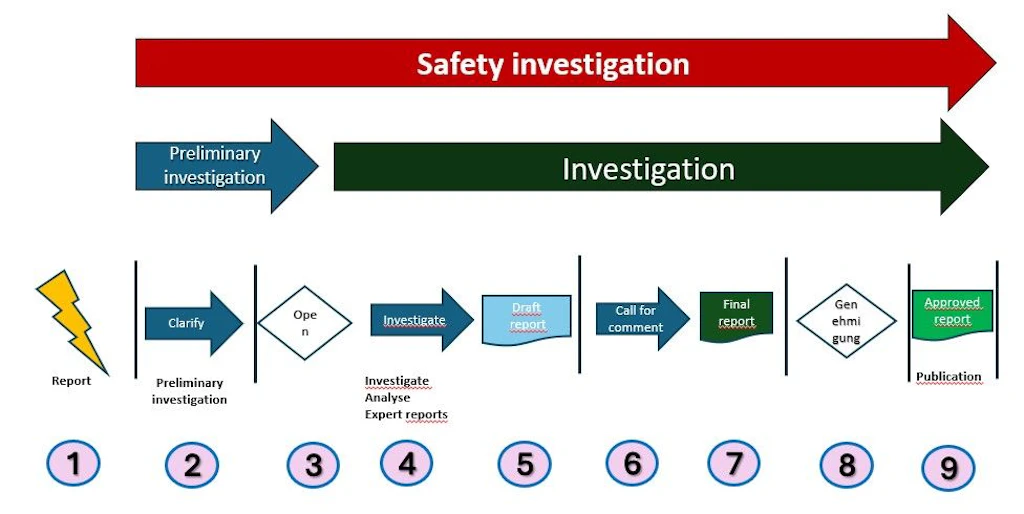
In the initial phase (2), data that could help clarify the causes and circumstances of the incident – in particular video recordings, audio recordings, journey data, flight paths and the operational status of safety systems – must be secured.
In the event of an accident, the an investigator(s) travel(s) to the scene of the accident. In cooperation with the cantonal police of the accident location, they investigate the scene.
Changes to the accident site may only be made without the consent of the STSB for rescue purposes and to prevent further damage (e.g. firefighting). Any changes must be documented. All data that could help clarify the causes and circumstances of the incident must be secured immediately by the competent authorities. The STSB decides, in consultation with the law enforcement authorities, on the release of the accident site, the wreckage, the objects involved in the accident or their components.
Based on the preliminary investigation, a decision is made as to whether the case is closed without further action, whether the findings of the preliminary investigation are published as a statement of facts (prevention bulletin), or whether a formal investigation is opened (3).
An investigation is opened if it can help to prevent further incidents or if there is an obligation to investigate under an international agreement. Otherwise, the STSB may decide not to open an investigation.
If an investigation is opened, the STSB draws up a preliminary report within the next few days containing initial information on the accident. This report comprises only essential details regarding the vehicle or aircraft involved, the personnel involved, the scene of the accident and the damage caused. It contains a brief description of the course of events, but no analysis. The preliminary report is distributed to the persons concerned and to the competent supervisory authority, and is published on the STSB’s website.
(4) The safety investigation conducted by the STSB comprises the accident scene survey, the preservation of evidence, the analysis of the available data (Flight Data Recorder (FDR), Cockpit Voice Recorder (CVR), flight data), photographic material (including that from third parties) and all available electronic storage media. In addition, interviews are conducted with persons who can provide useful informationand and further investigation files are examined. If necessary, the head of the investigation orders specialised examinations.
On the basis of the findings, the STSB draws up a draft final report (5).
If at any time during the investigation significant findings emerge that are relevant to accident prevention and require immediate action, the STSB draws up an interim report for the competent supervisory authorities even before the investigation is concluded. This report sets out the safety deficiency and contains corresponding safety recommendations or safety advice notices.
The draft final report is sent to the individuals and organisations concerned, as well as to the relevant supervisory authorities, with a 30-day deadline for comments. (6) Where necessary, the draft final report contains safety recommendations for the relevant authorities or safety advice notices for the relevant stakeholders.
The STSB reviews the comments received and takes into account the remarks and proposals made by the individuals, organisations and competent supervisory authorities that have submitted comments, provided these are justified and well-founded. The resulting final report (7) is reviewed and approved (8) by the Commission or the Head of the Investigation Bureau.
(9) Finally, the final report is published on the STSB’s website.
Safety recommendations and safety advice notices
As part of the safety investigation, the STSB identifies relevant safety deficiencies and makes recommendations on how these can be mitigated in future. To this end, it issues safety recommendations to the relevant authorities (in accordance with the ICAO Convention, Annex 13, EU Regulation 996/2010 and EU Regulation 978/2016) or safety advices notices to the industry concerned.
A safety recommendation does not in any way constitute an attribution of blame, nor does it address the question of liability.
Ideally, the individuals or organisations concerned will rectify the identified shortcomings during the course of the investigation, so that no safety recommendations are required. The measures taken since the accident or serious incident to improve safety on railways and ships are also published in the final report.